Begin Every Day with a Grateful Heart
A Designer’s First Look: Calm, Clear, and Commercially Smart
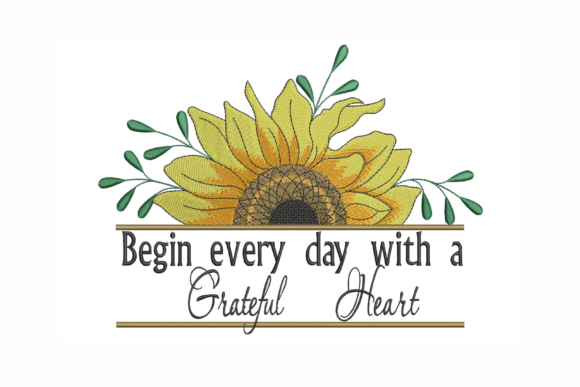
When I opened Begin Every Day with a Grateful Heart for the first time, I didn’t see just another inspirational embroidery file—I saw a quiet anchor. The layout is centered, gently curved, with soft letter spacing and a subtle heart motif integrated into the word “Heart.” It doesn’t shout. It breathes. That’s rare in machine embroidery designs that lean into sentiment—many tip into cutesy or cluttered territory. This one holds space. It feels intentional, not decorative. As a designer who’s stitched hundreds of phrases onto sweatshirts, tote bags, and baby blankets, I immediately pictured it on a natural linen tea towel—clean, grounded, and quietly meaningful.
Where It Lives Best: Real Projects, Real Impact
I tested Begin Every Day with a Grateful Heart across three real-use scenarios: a custom embroidered tote for a local wellness studio, a set of matching sweatshirt-and-pillow-cover pairs for a new mom’s nursery gift, and a small-batch run of embroidered patches for an Etsy craft shop. In every case, the design performed like a trusted collaborator—not flashy, but consistently legible and emotionally resonant.
- Tote bag design: Stitched on medium-weight canvas with tear-away stabilizer, the text remained crisp even at 4.5” wide. No letter crowding, no thread nesting in the curves—just clean satin stitch edges and balanced fill stitch density.
- Sweatshirt embroidery: On a midweight cotton-blend hoodie, the phrase sat comfortably above the left chest. The heart detail stayed distinct without requiring extra underlay—no puffing or distortion, even after gentle washing and tumble drying.
- Baby embroidery: Used on a 100% cotton receiving blanket (with lightweight cutaway stabilizer), the design read clearly from across the room—and more importantly, felt tender, not generic. Parents commented on how “soft” it looked, which matters deeply in nursery decor.
Where to Pause—and Why
This isn’t a one-size-fits-all embroidery file. Its thoughtful pacing means it needs breathing room. I wouldn’t recommend Begin Every Day with a Grateful Heart for anything smaller than a 4” hoop unless you’re confident in scaling down without losing letter clarity. The “Grateful” curve tightens slightly near the heart, and shrinking too far risks blurring that nuance.
It also asks for honest fabric prep. On stretchy knits (like lightweight t-shirts), skip light stabilizer—it’ll shift. Use a medium-weight cutaway and baste first. On dark fabrics, test your thread contrast: a warm cream or oatmeal tone reads warmer and more personal than stark white. And avoid dense, textured surfaces like heavy bouclé or quilted caps—the design’s grace depends on smooth stitch definition.
What It Adds to Your Finished Product
Stitching Begin Every Day with a Grateful Heart doesn’t just add text—it adds intentionality. Customers notice that. A boutique owner told me her customers specifically asked for the “gratitude phrase” after seeing it on a pillow cover—because it felt handmade *and* human, not mass-produced. That trust transfers. When you use this as part of your craft business, it supports brand consistency for mindful, values-driven shops—think yoga studios, therapy practices, or slow-living subscription boxes.
It also lifts perceived value without demanding premium pricing. A $28 embroidered tea towel feels elevated because the phrase lands with sincerity—not salesmanship. Same for personalized gifts: stitching it on a child’s backpack or a teacher’s apron carries weight. It’s not filler. It’s framing.
Practical Designer Notes You’ll Actually Use
Before you load Begin Every Day with a Grateful Heart into your machine or list it in your Etsy shop, here’s what I do—every time:
- Test on scrap fabric first, using the exact stabilizer and thread colors you plan to use. Watch how the heart shape behaves on your target material.
- Check stitch density visually—not just in software. Dense fills can flatten on plush fabrics; too-light density looks washed out on dark backgrounds.
- Confirm hoop size compatibility. If your smallest hoop is 3.5”, verify the design scales cleanly before committing to a batch.
- Inspect corners and curves in black-and-white mockups. Some hearts lose shape when converted to grayscale previews—this one holds up well.
- Compare light vs. dark fabric backgrounds side-by-side. The phrase works on both, but thread choice changes the mood entirely.
- Use proper stabilizer for your base layer— especially for commercial embroidery or items meant for frequent washing. A flimsy backing undermines the message.
- Review licensing before selling finished items. Since this is marketed as a machine embroidery design for apparel and accessories, confirm whether resale of physical products is permitted—and whether digital redistribution is restricted.
Final Thought: Not Just Embroidery—A Quiet Design Choice
Begin Every Day with a Grateful Heart won’t win awards for complexity. It doesn’t need to. What it does—consistently, quietly, and effectively—is align meaning with execution. It’s the kind of embroidery file that makes your tote bag feel like a promise, your baby blanket feel like a lullaby, and your Etsy listing feel like a conversation starter. For designers, crafters, and small shop owners who care about how words land—not just how they look—this is a reliable, resonant, and refreshingly unhurried addition to your embroidery project toolkit.