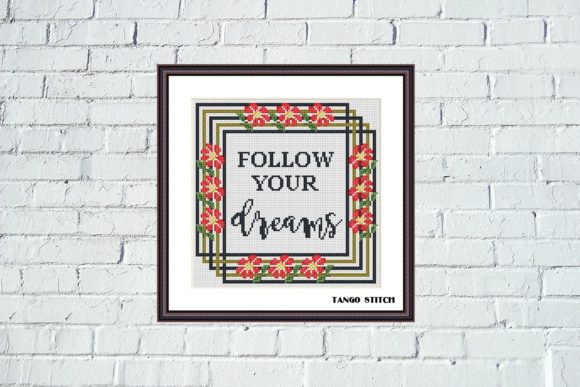
Follow Your Dreams Floral Cross Stitch
A Craft Fair Designer’s First Look: Bold, Uplifting, and Booth-Ready
As someone who’s stitched, sold, and styled hundreds of designs at regional craft fairs and handmade markets, my first impression of Follow Your Dreams Floral Cross Stitch is immediate and positive: it reads as warm, optimistic, and intentionally decorative—not cutesy or generic. The floral framing around a clear motivational phrase gives it farmhouse charm with modern clarity. It lands somewhere between elegant and approachable—ideal for buyers seeking meaningful handmade products without overly precious or trendy styling. That balance is rare, and it’s why this design stands out in a sea of minimalist quotes or over-complicated botanicals.
Where It Shines on Real Craft Fair Products
This isn’t just a pattern—it’s a versatile craft fair product engine. On a natural linen tote bag, Follow Your Dreams Floral Cross Stitch becomes an instant conversation starter: large enough to read from three feet away, yet detailed enough to invite closer inspection. As apron embroidery, it anchors the chest pocket area beautifully—floral elements soften the formality of text, while the 20 x 20 cm size ensures strong visual presence without overwhelming the garment.
For tea towel embroidery, the design holds up exceptionally well on medium-texture cotton—weave doesn’t swallow the floral outlines, and the balanced stitch density prevents puckering. As an embroidered patch, it translates cleanly when scaled down to 3–4 inches, especially if simplified slightly for machine-stitched versions (more on that below). On pillow covers and fabric pouches, it adds boutique-level charm without demanding premium pricing—making it perfect for small shop product lines targeting gift buyers and self-purchasers alike.
What Works Online—and What Needs Careful Handling
Follow Your Dreams Floral Cross Stitch photographs brilliantly for Etsy listings and digital mockups. Its symmetrical layout, clear contrast against white Aida, and floral framing create strong visual hierarchy—ideal for thumbnail visibility. As a digital embroidery file or printable mockup, it supports clean, consistent branding across social media and product galleries.
But caution is needed where detail meets reality. The description notes it’s designed for 14-count White Aida—so lettering and inner floral motifs will be legible *at that scale*. Shrinking it for caps or curved surfaces risks losing definition in the “Follow your dreams” text. Similarly, dense stitch areas may not relax well on thick fabrics like canvas market bags or textured tea towels unless paired with appropriate stabilizer and adjusted tension. Dark fabric? You’ll need high-contrast thread colors—test before batch production.
Production Practicality: Speed, Clarity, and Consistency
This design scores highly for batch production. Its symmetry and repetition (especially in floral motifs) make it predictable for both hand and machine work. There’s no tiny isolated detail that slows down stitching or causes frustration at craft fair deadlines. As a machine embroidery design, it’s likely adaptable across hoop sizes—but verify actual stitch count and file format before licensing. For hand-stitchers selling finished goods, the 20 x 20 cm footprint means you can produce multiple pieces per yard of Aida, maximizing material efficiency.
It also works equally well as a focal point *or* an accent—scale it up for pillow covers, simplify and center it for patches or cap fronts. That flexibility makes it a smart investment for Etsy sellers juggling multiple product types under one cohesive brand story.
Designer Notes You Can’t Skip
- Test on scrap fabric first—especially if using non-Aida substrates like linen-look cotton or terry cloth tea towels.
- Check thread contrast on your intended base fabric. Light florals vanish on ecru; dark text fades on charcoal.
- Review spacing between letters and petals—if too tight, it’ll blur on textured surfaces.
- Confirm hoop size compatibility before digitizing for commercial embroidery machines.
- Inspect stitch density in petal clusters—overcrowded zones cause stiffness and visible distortion on soft fabrics.
- Use cutaway or tear-away stabilizer depending on fabric weight and stretch—don’t skip this step for aprons or tote bags.
- Create at least one real mockup—not just digital. See how light hits the stitches in person, how it feels in hand, how it pairs with your booth palette.
- Compare fabric colors side-by-side—natural light changes everything. A cream background may mute pink threads; oatmeal linen may warm yellow accents unexpectedly.
- Confirm commercial licensing before selling finished products. This is a Graphics-type Cross Stitch Patterns asset—rights vary by seller.
Why It Builds Booth Strength and Buyer Trust
In a crowded craft fair aisle, Follow Your Dreams Floral Cross Stitch delivers emotional resonance *and* aesthetic cohesion. It signals care, intention, and handmade quality—not just decoration. Customers notice it because it feels personal, not mass-produced. When stitched onto a tea towel beside a matching embroidered pouch, it reinforces brand consistency. When displayed as a framed sample next to raw materials (threads, Aida swatches), it invites engagement: “How long does this take?” “Can I get it in blue?” “Do you do custom names?” That’s how sales begin.
It also elevates perceived value. A plain tote sells for $28. A tote with Follow Your Dreams Floral Cross Stitch—cleanly executed, thoughtfully framed—justifies $38–$45. Buyers pay for meaning, craftsmanship, and visual harmony—and this design delivers all three without shouting.
Final Thought: A Reliable, Uplifting Workhorse
Not every cross stitch pattern earns repeat orders from craft fair regulars. Follow Your Dreams Floral Cross Stitch does—because it’s uplifting without being saccharine, floral without being fussy, and structured without feeling rigid. It fits seamlessly into spring markets, graduation seasons, and small business gift bundles. Whether you’re an Etsy seller scaling digitally or a boutique maker stitching samples by hand, this is a handmade product foundation worth building on. Just remember: test, adapt, stabilize, and always—always—verify licensing before turning it into your next best-selling commercial embroidery line.